
Eight Dimensions – Resiliency 
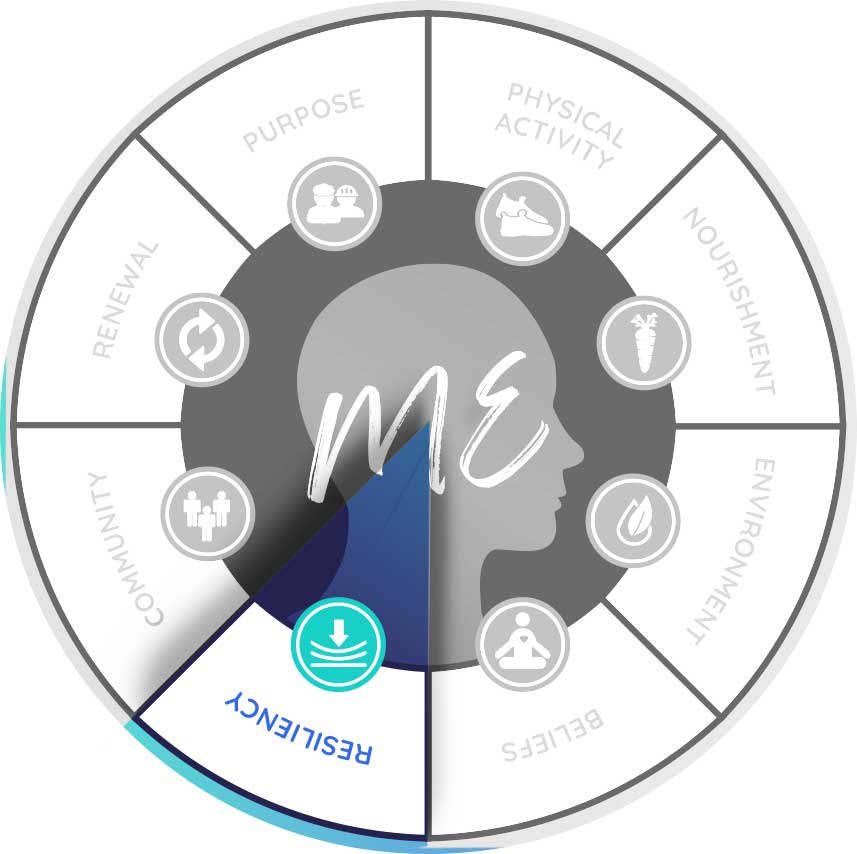
Eight Dimensions Chart focused on Resiliency

Everyone goes through tough times in life, that’s part of being human. Your ability to make it through these tough times is your resilience.  

Different people face different types of challenges and adversities. Certain groups of people like those in marginalized communities or who have different socioeconomic backgrounds may face more challenges and adversities from the outside world.  

While everyone faces different challenges, every individual has the potential to increase their resilience and their overall well-being.

What is resilience? 

Resilience is someone’s ability to adapt to stressors or “bounce back” after a difficult situation. Life has its ups and downs, everyone will face some types of stress and crises.  

Having resilience allows you to maintain your psychological well-being despite what happens and know what tools you need to overcome difficult situations.  

When you learn to cultivate more resilience, you feel more grounded and can confidently overcome life’s challenges, both big and small. Resilience plays a large role in your overall health and ability to live a balanced life.

Types of resilience

When you think of resilience, you may think of huge life challenges like losing a job, experiencing a loss in your family, or dealing with health challenges. It’s important to have resilience in these situations, but resilience also shows up in your daily life.  

Think about a day when you’ve had frustrating things or challenges arise. You might not have gotten enough sleep, are running late to work or school, or disagree with someone. These things happen, it’s part of life, but having the skills, tools, and perspective to bounce back and not have these hiccups ruin your day or week is important. 

Resiliency is a daily practice, but it all adds up. The more you develop resilience in your daily life, the easier it will be to have it when something big happens.  

Resilience and psychological health

Resilience and psychological health have a direct connection. Developing resilience can help support your psychological health and vice versa, having positive mental and psychological health can help you have more resilience.   

Often more resilient people have learned how to manage their stress. This can happen as you get older and learn new skills, as well as by being proactive about developing these skills over time.  

Being resilient doesn’t mean you don’t get stressed, but when you do you manage that stress. This includes coping mechanisms like if you’re irritated with someone taking some time to yourself to calm down versus reacting and saying something that you regret. Positive coping mechanisms help you regulate your emotions to handle obstacles better when they arise.  

Being adaptable is also a sign of resilience. When things don’t go as planned, can you adapt to the changes without feeling dysregulated? Can you problem-solve to find different solutions to situations that arise? These are all ways your psychological health can increase your resilience.  

Resilience and physical health 

Resilience may also help support your physical health. Stress is one of the biggest risk factors for many chronic health concerns like cardiovascular diseases, high blood pressure, obesity, and diabetes.  

When you can better navigate stress thanks to resilience your mind and body can adapt better. It can also decrease your risk of developing or worsening stress-related health conditions. Stress can also impact your immune system, impacting your body’s ability to fight viruses and infections. 

Developing resilience can also increase your overall quality of life. One aspect of resilience is your ability to see the bigger picture, maintain a positive perspective, and stay optimistic. Research has even found a link between being and having a longer lifespan!

How to increase resilience

Some people may be born with more resilience than others, but it is a learned skill. Anyone can learn new tools and techniques to help increase their resiliency to better deal with the hurdles they face in life.

Here are some of the top ways you can help build resilience: 

Find your support system 

No matter how resilient you are, everyone needs a support system around them to help make life easier to navigate. Your support system may include your family, friends, coworkers, or anyone else you can lean on for emotional support and advice.  

You can help build your support system by thinking about the people you trust most, reaching out to them when you need it, as well as offering support to them when they need it. 

Practice self-compassion

Everyone makes mistakes, but that doesn’t make you a bad person. Understanding your role in a situation can help you take personal responsibility for your actions and reactions and give compassion to yourself and those around you.  

Self-compassion is important in situations where you may have made a mistake and in situations where you may be facing adversity that was not your fault. Balancing personal responsibility and self-compassion helps you build resilience in uncomfortable or difficult situations. 

Physical activity

A surprising way you can increase your resilience is by engaging in physical activity. Physical activity helps regulate stress levels so you can be less reactive in stressful situations. 

It can also help you in another way. Challenging yourself, even by exercising or trying a new type of physical activity, helps build resilience in other areas of your life. 

Take action

It’s normal to feel “stuck” when triggered or faced with a challenge. Overcoming this feeling of being stuck or overwhelmed and instead taking action can help you become more resilient. 

Practicing solving problems, even in difficult moments, shows your brain that you can take action when you need to. It shows you have the skills and abilities to face and overcome challenges. 

Mental health support

If you have faced challenges or adversities that have affected your mental health, know that it’s not your fault. These challenges can affect your mental health and may affect your resiliency or belief in yourself. 

Getting mental health support can help get you to a place where you feel better equipped to deal with life’s challenges. A mental health practitioner or coach can help give you the tools you need to become more resilient and support your mental health. 

Practice self-care 

Being resilient isn’t just about being tough and taking action when needed. It’s also about nurturing yourself and practicing self-care when you need it. 

Self-care includes getting enough sleep, journaling, spending time with loved ones, and doing other things you enjoy. It can help to have a list of tools you turn to when you need help regulating your emotions. You can put simple tasks on this list like walking or taking a few deep breaths. Being able to regulate your emotions is an important part of self-care. 

Resilience for your well-being

You might not be able to change what life throws at you, but you can change how you react. Resilience is a key part of your overall well-being. Building resilience can help you better navigate life and the obstacles that come with it.  

Remember that no one is perfect, everyone gets overwhelmed or feels frustrated sometimes. But the more you practice resilience, the easier it will be to bounce back in the most difficult moments. 

References: 

  1. What is Resilience?  
  1. Chronic stress puts your health at risk – Mayo Clinic  
  1. How Does Stress Affect the Immune System? – UMMS Health  
  1. Optimism linked to longevity and well-being in two recent studies | National Institute on Aging  

Gut Check: The Link Between Gut Health and Mental Health

You may have heard sayings like “trust your gut,” “go with your gut,” or “a gut instinct.” These phrases all refer to an innate knowing or consciousness that comes from ​within us — specifically,​ our gut.

Interestingly, a growing body of scientific research reveals how our gut affects the rest of our bodies and even our mental well-being. This interconnectedness between our mind and gut health is becoming increasingly evident. In this article, we’ll review this connection and explore ways you can support your mental health by supporting your gut health.

What is the Gut-Brain Connection? 

You may not know but your gastrointestinal (GI) tract and your brain are constantly communicating with each other. This two-way conversation happens along what is called the gut-brain axis. It plays a crucial role in regulating both digestive function and mental function. This communication occurs through several pathways including: 

  • Enteric Nervous System (ENS) – two thin layers of more than 100 million nerve cells that line your GI tract, running from the esophagus to the rectum, and is often referred to as the second brain 
  • Vagus Nerve – one of the 12 cranial nerves that runs down and throughout your body 
  • Gut microbiome – the community of (friendly) bacteria and other microorganisms in your gut that produce or help produce chemical neurotransmitters 

Your Gut Health, Your Mental Health 

The gut-brain axis sends and receives information from your brain. The health of one can have a big impact on the health of the other. 

Stress Resilience

Recent studies shows that your gut health has a significant connection to how well you respond to and bounce back from stress. More specifically, people who are more resilient to stress have a microbiome that supports a reduction in inflammation and a strong gut barrier. This research suggests that a strong barrier enables the body to absorb nutrients better and blocks toxins that would create inflammation. If you have a weak barrier and lack the microbiome that prevents inflammation, a signal will make its way to the brain in the form of stress, priming your mind and body to be unable to let go of stress mode. 

Depression

The link between gut health and depression is becoming increasingly clear. One study discovered that people with depression and anxiety had less of a certain kind of bacteria related to the production of these short-chain fatty acids than others. Another study found gut microbiomes that lacked bacteria diversity often correlated with people living with depression.  

Mood Changes 

If you or someone you know is living with irritable bowel syndrome (IBS), constipation, diarrhea, and other stomach issues, you may notice mood shifts. That’s because your gut-brain axis communicates this irritation to the central nervous system — resulting in mood changes. A high percentage of people with these stomach issues often develop depression and anxiety, too. 

Taking Care of Your Health

Now you know the impact your gut health has on your mental health. How can you use this knowledge to support your mental health?  

Gut Healthy Diet 

What you eat plays a key role in maintaining a healthy gut. Certain foods can either promote or disrupt gut health. Try incorporating more: 

  • Probiotic foods and beverages like yogurt, sauerkraut, kefir, miso, tempeh, kombucha, and kimchi. 
  • Prebiotic foods like asparagus, apples, artichokes, bananas, oats, onion, garlic and prebiotic beverages.  
  • Soluble and insoluble fiber through fruits, ​vegetables​, beans, oats, legumes, barley, whole wheat, berries, and nuts. 
  • Antioxidants through ​vitamins ​C and E, beta carotene, and ​selenium-rich​ foods and drinks. 

In addition to what you add, it’s a good idea to consider what you need to take away. To reduce inflammation, consider saying no to foods with a high ​added sugar​ content, fried foods, packaged foods, and more. Studies suggest a link between eating highly processed foods and depression and anxiety. Don’t worry. There is room for most things in a healthy diet. So, you don’t have to go overboard in saying goodbye to a sweet treat or fast food forever. Let it be a ​“​nice to have sometimes​”​ rather than a ​“​have all the time.​”​   

Download “Gut Check: Your Essential Starter Kit” for guidance and recipes to support your journey toward better gut health. This starter kit provides practical tips and delicious recipes to help you incorporate gut-friendly foods into your diet and make informed choices about what to avoid.

The VEBA Resource Center offers members virtual cooking classes. You can learn how to cook deliciously and nutritiously for your gut. We also have a library ​of ​cooking videos featuring recipes you’ll love. Learn more here. 

Regular Exercise

Exercising regularly can improve the health of your gut and, therefore, mental health. Exercising increases gut mobility, improves circulation, strengthens digestive muscles, boosts your metabolism, and improves your sleep — all things good for your gut. You don’t have to run a marathon or take up extreme weightlifting. Any movement sustained for at least 30 minutes that elevates your heart rate and brings a sweat but allows you to ​breathe enough​ to talk is your goal.  

You and your doctor know your health needs best. It’s important to check with them before trying any new exercise. If you get the ok, try to exercise five days a week. But don’t let the idea of perfection get in the way of the good. Some weeks five days may be doable, and some weeks it may not. One day is better than no days. Also, you can break up the 30 minutes into two 15-minute increments or three 10-minute increments.  

Approach exercise with realistic expectations of self and consider reaching out for support. Joining a gym, hiring a trainer, or asking a friend to be an accountability buddy can be a huge help. The VEBA Resource Center has a library of on-demand videos for members that lets you exercise wherever and whenever works for you. Take a look at what we have to offer. 

Meditation

Meditation and mindfulness practices are recognized as having many health benefits. We know it intuitively from the general feeling of wellness after a few moments of mindful breathing or listening to a guided meditation. A study confirmed that deep meditation regulates your gut microbiome, therefore, supporting your mental health. You can use tools like a ​meditation​ app, go for ​a ​walk in nature, ​do ​yoga, and more. The VEBA Resource Center also offers virtual meditation classes so you can practice when and where it works for you. 

Here for Your Whole Health

We’re ​here​ to help you live your healthiest life. ​California ​​Schools ​VEBA offers resources, information, and support in a way that works for you. In-person or virtually, we’re here for your whole health.  

Discover Your Personalized Path to Wellness 

Whether you’re navigating a health challenge or striving to enhance your overall well-being, our Whole Health Coaching Program is designed to support you every step of the way. 

Partner with a dedicated Whole Health Coach to create a personalized wellness plan that addresses your physical well-being, emotional/mental health, and daily life. 

This program is ideal for you if: 

  • You have a specific health goal or challenge you want to tackle. 
  • You value professional guidance and support. 
  • You are ready to commit to making positive changes in your life. 

Take the first step towards a healthier, happier you. For more details, visit calveba.org/whole-health-coaching. 

The Heart-Healing Power of Self-Care

We all experience stress in one way or another, and while short-term stress poses minimal risk to our health, chronic stress impacts our hearts more than you might think.

Prolonged stress is linked to high blood pressure, which significantly increases the risk of coronary artery disease, heart attack, and heart failure. Beyond just the physical toll, stress impacts emotional health by affecting your thoughts, actions, and feelings. This may cause you to feel frustration, fatigue, or have difficulty focusing, potentially impacting your work performance.

Learning to manage and lower your stress through self-care practices is one way to live a heart-healthy lifestyle. Self-care means taking the time to do things just for you to improve both your physical health and mental well-being. Even small acts of self-care in your daily life can have a big impact.

Love your heart by loving yourself! Below are some tips for embracing self-care to reduce stress and lower your blood pressure.

Make Time for Yourself

Self-care can help you manage stress, lower your risk of illness, and increase your energy. Not sure where to start on your self-care journey? Download this FREE self-care toolkit! Included are an assessment to help you identify your current self-care routine, an action plan for you to start implementing more self-care in your life, and a self-care bingo game to challenge yourself to try new self-care activities.

Daily Challenge: Elevate Your Day with Breathwork!

Take a moment today to practice mindful breathing. Inhale deeply for a count of four, hold for four, and exhale for four. Want to practice more mindful breathing? Check out our full video for a calming and invigorating breathwork session with our VRC Care Navigator, Michelle McNiff.

Get a Good Night’s Sleep

Your well-being isn’t limited to daylight hours alone.

It’s recommended that adults get at least seven or more hours of sleep per day. A 2023 study conducted by researchers at the University of Arizona found that even just a few poor nights of sleep could cause a sudden spike in blood pressure. Taking steps to achieve quality sleep can notably decrease your vulnerability to obesity, heart and kidney disease, diabetes, and even stroke.

Do your worries or what you need to do the next day keep you awake at night? Before bedtime write down the most pressing worries of the day. Also, make a to-do list for the next day and prioritize the top 2-3 items. This way you can file your worries and priorities away for the next day, so they don’t take up any mental bandwidth in your mind at night. For more tips on how to set yourself up for a good night’s sleep, read this blog!

Set Boundaries

Setting boundaries is an act of self-love. By establishing your limits, you not only safeguard your well-being but also communicate your values, beliefs, and priorities to others. It demonstrates that you deserve to be treated well and ensures supportive and respectful relationships.

But while everyone can have boundaries, the hard part is enforcing them. Here are some tips:

  1. Listen to your gut. If something doesn’t feel right, say or do something about it.
  2. Think realistically. Ask yourself if you’re asking for too much, or if the person is truly capable of making this change.
  3. Set the bottom line and hold it. Be clear when communicating your limits, and be strong in enforcing them.
  4. Let others set boundaries, too. When you communicate your limits, respect the person’s point of view, resist the temptation to get defensive, and consider what they need from you.
  5. Anticipate change. Setting boundaries can alter your relationship, so be prepared and offer the person time and space to process this new way of interacting.
  6. Ask someone else to hold you accountable. Holding the line can be difficult, so find someone to back you up and keep you in check.

Want Help Setting Boundaries?

As a VEBA member, you have access to Optum Dedicated Consultants through the VEBA Resource Center. This Optum partnership allows you to receive assistance quickly for a variety of issues — from stress and relationship issues to communication strategies and beyond. This is a no-cost service to VEBA beneficiaries only.

Appointments are available:

  • In-person at the VRC – Kearny Mesa location
  • Virtually by phone or video consultation

To schedule a consultation, click here.

Through Optum, you and your dependents can also schedule consultations through Emotional Wellbeing Solutions. Please note: you may experience longer wait times with this option. To schedule an appointment through Optum directly, call 888-625-4809 or visit liveandworkwell.com (Access Code: VEBA).


Thank you to our content partners at Sharp HealthCare and Healthwise.

An Act of Gratitude a Day Keeps the Doctor Away

The dawning of a new year is often when we think about the things we are grateful for. However, experts reveal actively practicing gratitude can improve our lives year-round.

What is Practicing Gratitude?

Practicing gratitude means saying “thanks” and appreciating everything important to you and good in your life.

Benefits of Practicing Gratitude

According to researchers at the University of California, Davis, gratitude can improve emotional and physical health and help to strengthen relationships. Those who practiced gratitude, they found, regularly reported they:

  • Felt generally positive about their lives and optimistic about the future
  • Exercised more regularly
  • Experienced fewer negative physical symptoms and illnesses
  • Were more likely to make progress toward reaching personal, academic, and professional goals
  • Felt more alert, energetic, enthusiastic, and attentive
  • Noticed improved moods, greater self-esteem, and higher levels of positive emotions
  • Had a better sense of feeling connected to others
  • Experienced better-quality sleep
  • Were more empathetic and more likely to help others
  • Experienced less negativity and improved resilience in trying times

Ways to Practice Gratitude

Gratitude can be practiced in a variety of ways, both small and large. Practicing gratitude means saying “thanks” and appreciating what’s important to you. Here are some tips that can help you get started.

  • Take time each day to reflect.
    • Spend a few minutes at the end of each day and think about, or write down, what you are grateful for that day. This could include people, events, or experiences.
    • Take note of the things and moments that bring you joy or make you feel grounded and refer to them in times of stress or anxiety.
  • Make time to thank people you know.
    • Call or email just to say “thank you.”
    • Write a letter to express your gratitude or appreciation.
    • Write thank-you notes and say “thank you” when you receive gifts or favors.
  • Thank people you don’t know.
    • Wave “thank you” when a person lets your car in during heavy traffic.
    • Write a letter to the editor of your local newspaper about something a stranger did for you.
  • Give thanks for the abilities you have.
    • Even if you are feeling burdened by your health, think about things that you are still able to do.
  • Start a family ritual of gratitude.
    • Give thanks before a meal.
    • Share what you are grateful for before going to bed.
  • Find creative ways to give thanks.
    • Plant a garden of gratitude.
    • Take pictures of things you are grateful for.

If we look at each day and all the little moments within it as a gift, our lives will improve in a variety of ways.


Thank you to our content partners at Sharp HealthCare and Healthwise.

The VEBA Resource Center offers Gratitude Meditation classes. You will be guided to focus on the positive in your life: as you open to soak in the good all around you, you naturally align with the state of receptivity and abundance. Great for beginner and advanced experience levels. Check out our calendar to sign up for an upcoming class.