
The Power of Prevention: Reduce Your Risk for Common Cancers

The National Cancer Institute estimated that in 2025, roughly 2 million people were diagnosed with cancer in the United States. Based on this research, breast, lung, prostate, and colorectal cancers account for almost 50% of all new cancer cases in the US.

With cancer affecting so many people each year, adopting preventive measures has become more important than ever. By focusing on lifestyle modifications and early detection, you and your loved ones can significantly reduce your chances of developing cancer and live long, healthy lives.

Learn about prevention, screenings, and lifestyle tips that can help protect you and your loved ones against these common cancers.

Skin Cancer

Did you know: Skin cancer is the most common type of cancer. It often appears on areas of the body exposed to the sun, such as the head, face, neck, back, chest, or shoulders.

Colon Cancer

Did you know: The American Cancer Society estimates that over 152,000 people in the U.S. will be diagnosed with colorectal cancer in 2026. However, the number of people diagnosed has steadily declined since the mid-1980s due to increased screening and changing lifestyles.

Lung Cancer

Did you know: According to the Lung Cancer Research Foundation, about 20% of lung cancer diagnoses occur in people who have never smoked, which is why awareness and screening recommendations are important for many adults.

Breast Cancer

Did you know: According to the American Cancer Society, the average risk of a woman in the United States developing breast cancer sometime in her life is about 13% and the median age at the time of breast cancer diagnosis is 62.

Prostate Cancer

Did you know: According to the American Cancer Society, about six in 10 prostate cancers are diagnosed in men who are 65 or older, and it is rare in men under 40. The average age of men when they are first diagnosed is about 67.


Don’t delay. Schedule your routine screenings and take proactive steps towards preventing cancer, as prevention truly is the best medicine. Download this infographic to see what other screenings you may need based on your age, and for appointment tips to get the most out of your visit. For more lifestyle tips that help with cancer prevention, read this blog.

Have you received a diagnosis or treatment plan and want to get a second opinion? As part of our CalVEBA medical plans, members can get a free expert second opinion through our partnership with Teladoc Medical Experts. This is a no-cost service that provides you with access to world-renowned doctors and specialists so you can have confidence before making major medical decisions.

Learn more at Teladoc.com/Medical-Experts or call 800-835-2362
Fertility After 35: Your Questions, Answered

It’s natural to wonder how age affects fertility. If you’re in your mid-30s or older and thinking about pregnancy, you may have questions about your chances of conceiving. While fertility does change over time, many people can still become pregnant after 35. Understanding how fertility shifts with age can help you feel more informed, prepared, and supported as you plan your next steps.

How does age affect fertility?

Age affects fertility differently in men and women. Fertility varies from person to person, and your genetics, health history, and lifestyle also play an important role. Here’s what typically happens.

Fertility in men

Changes tend to be gradual. Sperm quality and quantity begin to decrease around age 40. However, many men are still able to contribute to pregnancy later in life.

Fertility in women

Fertility usually peaks in the 20s and begins to decline in the early 30s. After 35, the decline becomes more noticeable. Typical monthly chances of conception are:

  • At age 30: about a 20% chance each month 
  • At age 35: about a 15% chance each month 
  • At age 40: about a 5% chance each month

These numbers can be helpful for context, but everyone’s fertility journey is unique.

What healthy habits support fertility after 35?

There are several steps you can take to support your reproductive health and prepare your body for pregnancy. These habits are beneficial whether you’re just beginning to plan or actively trying to conceive.

  1. Visit your primary care provider to ensure you are healthy enough to conceive and carry a pregnancy. 
  2. Stay current with routine screenings, preconception labs, and vaccinations. 
  3. Maintain a weight range that supports your overall health. 
  4. Take a prenatal vitamin with folic acid. 
  5. Avoid nicotine and cannabis. 
  6. Limit caffeine to under 200 milligrams per day. 
  7. Limit alcohol if you are trying to conceive.

These habits support your overall health and may improve your chances of becoming pregnant.

Can you increase your chances of getting pregnant after 35?

Tracking your menstrual cycle and timing intercourse during your fertile window can help. The fertile window includes the days leading up to ovulation and the day of ovulation itself.

If you’re trying to conceive through intercourse:

  • Aim to have intercourse one to two days before ovulation and on the day of ovulation. 
  • Many couples choose to have intercourse two to three times per week after a period ends to stay within the fertile window without added stress. 

If you are not using intercourse to conceive, options include:

  • At-home insemination 
  • Intrauterine insemination (IUI) 
  • In vitro fertilization (IVF) 
  • Using donor sperm 
  • Egg or embryo donation

Your doctor can help you understand which options might be right for you based on your personal goals and medical history.

When should you seek support if you’re having difficult conceiving?

If you’re over 35 and have been trying to conceive for at least six months, schedule an appointment with your doctor for an evaluation.

Here are recommended timelines:

  • Ages 35 to 39: seek evaluation after six months of trying 
  • Ages 40 to 42: seek evaluation after three months   
  • Ages 42 to 45 or older: talk with a doctor before trying to conceive to discuss your goals and understand your options

Early evaluation can help identify potential challenges and give you clearer next steps on your path to pregnancy.

Thank you to our partners at Sharp HealthCare and Kindbody.

Nutrition Tips for Healthy Aging

Good nutrition is important at any age, but it becomes especially important as you get older. Eating a balanced, nourishing diet helps keep your body strong, supports healthy aging, and can reduce the risk of chronic conditions. With a few simple adjustments, you can stay energized and feel your best.

As you age, your nutrition needs naturally shift. Your body may require higher amounts of certain nutrients (like vitamin B12, calcium, and vitamin D), but it may be harder to get them. This could be for many reasons. You might feel less hungry, have problems chewing, or find meal planning less enjoyable, especially if you live alone.

The good news: with a little planning, you can get the most nutrition from the foods you eat. The suggestions below can help. If you need more support, talk to your doctor. They may recommend meeting with a dietitian who can help you create a plan that works for you.

How can older adults use good nutrition to stay healthy?

Build a balanced foundation:

  • Eat a variety of foods to get a wide range of nutrients.  
  • Take a daily multivitamin with about 100% of the daily value (DV) for key vitamins and minerals (unless your doctor advises otherwise). 
  • Eat plenty of fruit and a variety of vegetables. Pick fresh, frozen, or no-salt canned options. 
  • Choose foods high in vitamin B12, such as fortified cereal, dairy, meat, poultry, fish, and eggs. 
  • Get enough calcium and vitamin D from foods like dairy, tofu, fortified orange juice, and leafy greens. 
  • Include protein every day from lean meats, fish, poultry, eggs, cheese, beans, nuts, and seeds. 
  • Aim to make at least half of your grain intake whole grains, including 100% whole wheat bread, whole grain cereals, and brown rice.

If constipation is a concern:

  • Eat high-fiber foods such as fruit, vegetables, whole grains, and cooked dried beans. 
  • Drink plenty of fluids (If you have kidney, heart, or liver disease and have to limit fluids, consult with your doctor before increasing the amount of fluids you drink). 
  • Ask your doctor if a stool softener may help. 

If chewing is uncomfortable:

  • Choose canned or cooked fruits and vegetables.  
  • Chop meat, use shredded meat, or add sauces and gravy to soften texture.  
  • Try soft protein foods like cottage cheese, eggs, peanut butter, or cooked beans. 

If grocery shopping feels challenging:

  • Consider grocery delivery services. 
  • Contact volunteer organizations for assistance. 
  • Ask family or neighbors for help.

If cooking has become more difficult:

  • Consider taking a cooking class, if you’re able 
  • Use a microwave for simple meals like frozen entrees or prepared foods. 
  • Join group meal programs through senior centers. 
  • Try meal delivery services such as Meals on Wheels. 

If your appetite has decreased:

  • Eat smaller meals more often. Try 4- 5 small meals a day instead of 1-2 large ones. 
  • Eat with friends, family, or in group meal programs to make mealtime more enjoyable.  
  • Ask your doctor if medications could affect your appetite or taste. 
  • Use herbs and spices to add flavor. 
  • Seek support if you think you may be depressed, as this can affect appetite and daily activities.

With a few simple strategies, you can nourish your body, support your well-being, and enjoy a vibrant, healthy life at any age.
 
Looking for simple, healthy meal ideas? Visit our Cooking & Nutrition Hub for recipes, guides, and more. 

The Importance of Preventive Care

Don’t wait until you’re sick to see your doctor. Preventive care isn’t just about avoiding illness—it’s about building a foundation for lifelong health.

What is Preventive Care?

Typically, you visit the doctor when you’re sick or something just doesn’t feel quite right. While you should always seek help in those instances, preventive care means taking proactive steps—like regular check-ups, screenings, and immunizations—to protect your health before problems arise.

These visits support early detection and give you and your doctor the opportunity to work together toward your personal health and wellness goals. During a preventive care appointment, your doctor will determine which tests or screenings are appropriate based on your age, gender, health status, and family history.

What’s Typically Covered?

Physical Exams

During a physical exam, your doctor will observe, listen, and gently examine your body to help identify symptoms, assess underlying conditions, and determine if further testing is needed. You’ll also have the chance to discuss any concerns, review your medical history, and review current medications.

Immunizations

Immunizations (or vaccinations) are one of the most effective ways to protect yourself from infectious diseases. They help your body build antibodies that recognize and fight illness if you’re exposed later.

Common immunizations include flu and tetanus shots, the measles, mumps, and rubella (MMR) vaccine, and hepatitis A and B vaccines.

Screenings

Member Moment

Meet Ginger
“It’s very hard to look your kids in the eye and tell them that you have cancer. When they told me I was cancer free, I felt like I could breathe for the first time. I had great insurance, and I know our members do too, so I hope this is encouraging them to get their yearly checkups.” – Ginger, Member since 2013

Watch Ginger’s full member moment here.

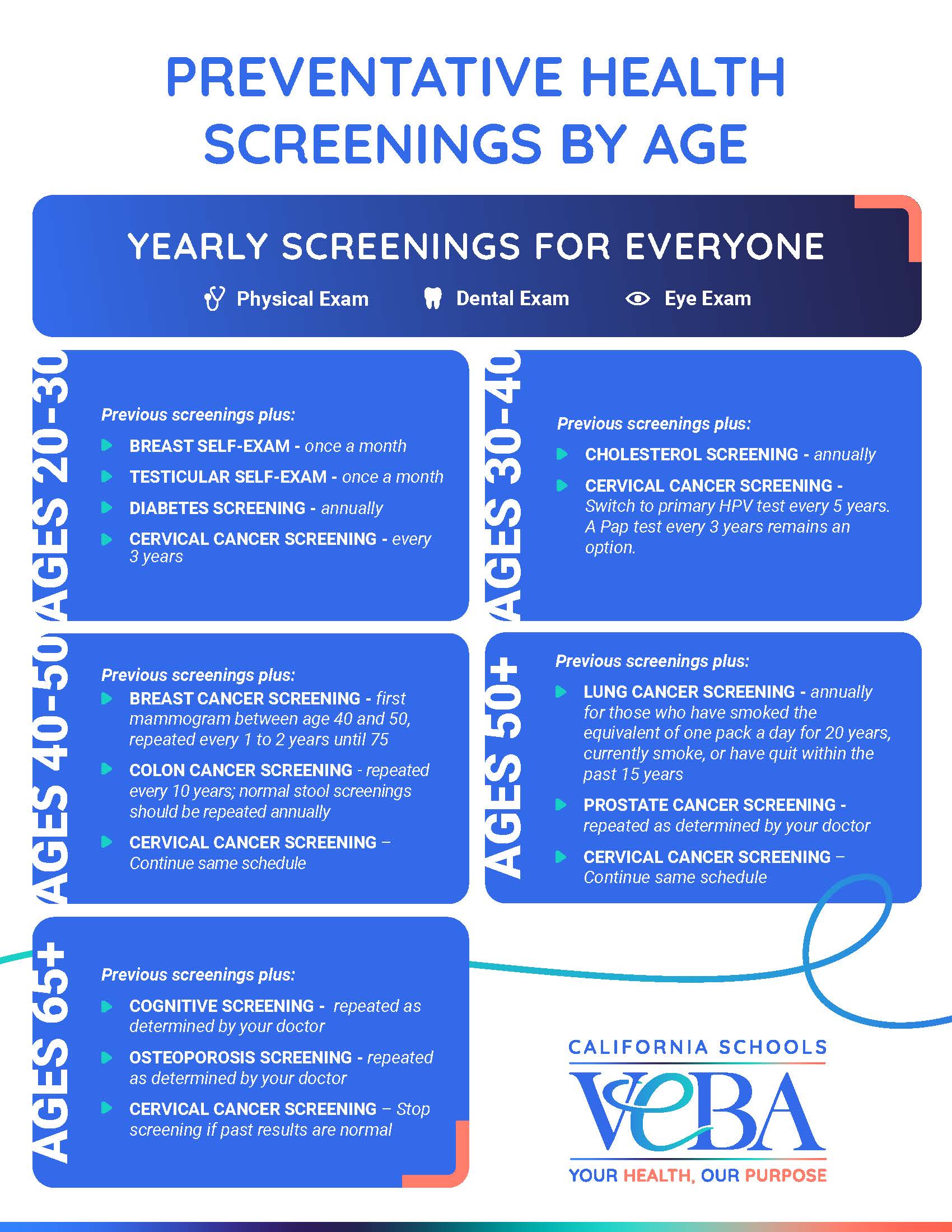
Screening tests help detect certain diseases before symptoms appear. Early diagnosis often leads to better outcomes and can prevent or delay complications. Use the infographic below to see which screenings may be recommended for your age group.

Preventative Health Screenings by Age, CalVEBA Infographic

Disclaimer:

This is a general guide for average-risk individuals. Higher risk may require more frequent screening. Consult with your health care provider.

Appointment Scheduling Tips

Preventive care appointments are usually covered at no cost with in-network providers. Check your plan documents to confirm coverage and costs.

Make the most of your doctor’s appointments by being well-prepared and organized using our Appointment Ready: Your Doctor’s Visit Prep Guide.

Here are some tips to help you get started:

Before Your Appointment:

  • Make a List: Bring a list of medications and jot down questions or concerns.
  • Bring Your Insurance Card: Download and save to your mobile wallet for easy access.

During Your Appointment:

  • Arrive Early: Arrive 10-15 minutes early to complete any paperwork. 
  • Dress Comfortably: Wear a shirt or loose-fitting sleeves for your blood pressure check. 
  • Use Your List: Review your list with your doctor. 
  • Speak Your Mind: Your time and health are valuable! 

After Your Appointment:

  • Follow Through: Take prescribed medications as directed and schedule any recommended follow-ups or screening. 
  • Speak Up: Report new symptoms or concerns promptly.  
  • Get a Second Opinion: If you’re unsure about a diagnosis or treatment plan, CalVEBA members can access second opinions from world-renowned specialists at no cost through our partnership with Teladoc Medical Experts. 

Preventive care can help you stay ahead of health issues and maintain overall well-being.

Download our Appointment Ready: Your Doctor’s Visit Prep Guide today and start planning for your next preventive care visit!


Thank you to our content partners at Sharp HealthCare and Healthwise.

Need help to schedule an appointment or have questions about your medical coverage? Contact the California Schools VEBA Advocacy Team here or call 888-276-0250.

Five Tips to Support Your Mental Health During the Holiday Season 

The holidays can be a time of togetherness, joy, and fun. It can also be a time of stress, loneliness, and anxiety that can take a significant toll on your mental health. If you find yourself stressed before or during this time of year, you’re not alone.

A recent ​American Heart Association (AHA) survey​ found that most people take weeks to de-stress after the holidays. Almost all respondents reported that they regretted not making time to rest or enjoy the season. Knowing the challenges during this time of year, you can proactively put in guardrails to protect your mental health. Let’s review some tools and skills that can help.

1. Set Realistic Expectations

From dishes to events to outfits to gifts, there are a lot of expectations for this time of year. Often, we set unachievable goals and, therefore, set ourselves up for the disappointment that comes when those goals are not met.

It’s important to step back and ask if our expectations for ourselves and others are too high. Recipes may not turn out as they looked on Pinterest, children may not use their manners when grandparents are over, your house may not be immaculate, and you may be late to an event.

If you expect perfection, even small hiccups can feel like disasters. Setting realistic expectations is a game changer. It helps ease anticipation, reduces stress, and creates space to enjoy the season.

If you’re feeling pressure to meet every expectation, remember that CalVEBA offers mental health support to help you navigate life’s challenges. Learn more here.

2. Draw and Hold Boundaries – It’s Ok to Say No

Putting in place frameworks for what is ok and not ok for you is an essential to-do over the holidays. Boundaries help us maintain who we are, stop others from taking advantage of us, invigorate our relationships, give us space to respectfully speak our minds, and open us to empathize with others. Healthy boundaries over the holidays could look like​ this​:

  • Not answering emails or work calls after hours or on your scheduled time off.
  • Saying no to invites when you want a quiet night at home.
  • Expressing discomfort to a relative who wants to talk about politics.
  • Politely asking others to respect your physical personal space. 

When our boundaries aren’t respected, we often feel unsettled. Many people ignore that discomfort to avoid conflict. This year, challenge yourself to let others manage their own reactions. Respectfully expressing and maintaining your boundaries is essential to your mental well-being.

3. Balance Your Schedule

Calendars fill up quickly during the holidays — often overflowing. It may seem impossible to manage and curate your schedule. More than half of the people surveyed in the AHA study reported that they had trouble making time for healthy eating, exercising, and getting adequate sleep this time of year. But finding balance in your day and week can keep you on your holiday schedule while ​keeping​ your stress in check.  

As you make a list of must-dos, be sure to include nutritious meals, exercise, sleep needs, and decompression time. Draw healthy boundaries around your time, knowing that you must show up for yourself before you can for others over the holidays. Block time on your calendar for self-care. Treat it like any other important commitment. You may not be able to make a 60-minute yoga class, but stretching at home for 15 minutes can be just as impactful. Five minutes of peace alone — wherever you can find it — can make a huge difference in your day.

Try CalVEBA’s virtual yoga, nutrition, and movement classes from wherever you are to help you recharge on your own schedule. Get started here.

4. Practice Mindfulness Regularly

Stress can sneak up on us. It might start with a few quick breaths and a clenched jaw, then escalate quickly. Tuning into your body throughout the day is an important step in managing your stress over the holidays. Meditation, yoga, journaling, ​and ​walking​​ are ​all ​great ways to cultivate awareness of what’s going on with you. From that knowledge, you can practice breathing techniques, use a self-soothe kit, or other coping techniques to regulate yourself. Then, you can start to address what’s causing the stress.  

5. Lean on Support

Help can be asking a coworker to assist with a project, a parent to watch your child for a few hours, or a friend to pick something up for you when they’re running errands. It can also be asking for someone to listen to you as you talk through something, company as you go for a walk, or someone simply holding space with you. Over the holidays this year, look to your family, friends, and coworkers for support and don’t forget to check in on others as well. Checking in with others can be a meaningful way to connect and support each other. You can also lean on the Resource Center. We offer programs and resources to help you live your healthiest life. 

Looking for More Support?

The holidays can be a time of joy but also stress and anxiety. Prioritizing your mental health is essential to navigating this season with resilience.

As a CalVEBA member, you have access to:

  • Mental health care through CalVEBA and your medical plan
  • Virtual wellness classes including yoga, fitness, and meditation
  • Self-care toolkits focused on mental well-being, nutrition, and on-demand videos

Visit calveba.org/Resources/ to explore programs that support your total well-being. 

Trusting Your Gut When It Comes to Health Care 

When choosing your health care team and your health plan, you want to make decisions based on reliable and sound information. This information can come from different sources like provider reviews, plan certifications, cost analysis, and more. There’s another source of insight that’s often overlooked: your own instincts. Your gut can help you evaluate your experiences and whether your needs are truly being met. When you listen to that inner voice, you’re better equipped to make the right decisions for your health.

Feel Seen & Heard: What Makes a Good Doctor-Patient Relationship?

Studies have shown that a good provider-patient relationship can lead to better outcomes, fewer errors, lower costs, and a more positive experience overall. But what does a good relationship look like?

Experts have identified five key pillars:

  • Respect
  • Engaged curiosity
  • Focused listening
  • Mutual participation
  • Provider self-awareness

Roundtable Discussion

These pillars can’t be objectively measured, but rather, they’re felt between a provider and patient. If you feel heard, respected, and involved in your care, that’s a sign you’re in the right hands. Watch CalVEBA’s roundtable to hear medical experts talk about the “green flags” to look for in a provider.

Save Money & Reduce Stress: Staying In-Network Matters

Once you’ve found a provider that you feel confident and comfortable with, you’ll want to pay attention to your health plan’s network. Providers can leave or join networks throughout the year. Staying in-network usually means lower out-of-pocket costs. If your preferred provider is out-of-network, that may be a sign to start comparing plan options during Open Enrollment.

Time to Check-In: How Do You Feel About Your Health Plan?

Studies show that many insured adults face challenges with their health plan carriers and those in poorer health often struggle even more. This Open Enrollment season, take a moment to reflect:

  • Has it been easy to get information from your health plan?
  • Do you feel valued as a member?
  • Are your needs being met?

Your Experiences Matter: Let Your Feelings Guide You

From choosing a doctor to choosing the right health plan for you, health care decisions can be stressful. They can affect your health, finances, and peace of mind. While it might feel risky to factor in your emotions, your feelings are a valid and powerful tool. As you evaluate your feelings about your health care experiences, ask yourself:

  • Do you like your doctor?
  • How did your last visit make you feel?
  • Did you feel listened to and respected?
  • Is it easy to get an appointment?
  • What did you like or dislike about your experiences with doctors, hospitals, pharmacies, and your health insurance carrier over the past year?
  • Can you refill prescriptions without hassle?
  • Are billing and claims questions answered clearly?
  • Do you feel confident in the care and coverage you’re receiving?

Take the Next Step: Turning Insight into Action

Once you’ve taken the time to reflect on your experiences and feelings, the next step is knowing where to turn for support. Whether you’re looking for a provider who truly listens or trying to navigate your health plan options, CalVEBA offers tools and resources to help you make informed, confident choices.

Five Open Enrollment Tips to Help You Find a Health Plan That Fits Your Needs

Health care isn’t one size fits all, and your health plan shouldn’t be either.

Choosing the wrong health plan can cost you more than just money—it can affect your care, your time, and your peace of mind.

Whether you’re managing chronic conditions, planning for fertility, or simply aiming to stay well, your health plan should reflect your unique needs. With so many terms and options, it’s easy to feel overwhelmed.

That’s why CalVEBA is here to help. Use these five tips to choose a plan that works for you and your family.

1. Know When and How to Enroll

Mark your Open Enrollment dates on your calendar now to avoid missing any crucial deadlines.

Missing your enrollment window could mean going without coverage or paying more than you need to.

Your employer’s Open Enrollment dates are unique. Please contact your Benefits Administrator for more information on your enrollment period to ensure you sign up for coverage within your window.

If enrolling through your employer, each organization will have a different process for where and how to enroll. Many streamline this process by making it available online. Again, this depends on your employer, but you can typically find this information through your HR representative.

2. Evaluate Your Current Health Care Needs

Since there’s no one-size-fits-all plan, it’s important to take inventory of what type of health care you need to feel your best.

This includes basic things like emergency and primary care coverage, but other services may also be important to you. When assessing your current needs ask yourself:

  • Do I take certain medications regularly?  
  • Do I need access to mental health care?  
  • Do I need comprehensive reproductive health coverage?  
  • Do I see alternative practitioners covered by insurance like acupuncturists or chiropractors?  
  • Do I need dental or vision coverage?  

It can be helpful to review the types of care you’ve used most over the past couple of years to identify your top priorities. While health care needs can change, it’s important to be mindful of which ones tend to stay the most consistent for you.

Also, make sure the plan you choose covers the 10 essential health benefits outlined by the Affordable Care Act (ACA). These benefits include:

  • Ambulatory patient services (outpatient care without hospital admission) 
  • Emergency services 
  • Hospitalization (including surgery or overnight stays)  
  • Pregnancy, maternity, and newborn care  
  • Mental health and substance use disorder services  
  • Prescription drugs 
  • Rehabilitative and habilitative services and devices (these help people with injuries, disabilities, or chronic conditions gain or recover mental and physical skills) 
  • Laboratory services  
  • Preventive and wellness services and chronic disease management 
  • Pediatric services, including oral and vision care (note: adult dental and vision coverage aren’t essential health benefits)  

Be cautious of plans that seem too good to be true. While they may offer lower monthly premiums, they often don’t cover these essential benefits and may come with high out-of-pocket costs.

3. Consider Your Future Health Care Needs

Planning ahead helps you avoid unexpected costs and ensures your plan grows with you. Your health care plan shouldn’t just account for your current health care needs, it also needs to be able to cover you for future ones. Future health care needs include ones you may or may not anticipate or be planning.

These are just a few potential changes to consider when looking at health care plans: 

  • Fertility planning   
  • Changes in medications  
  • Age-related screenings like colonoscopies or mammograms  
  • Unexpected accidents or illnesses 

While you can’t predict the future, choosing a plan that offers flexibility and comprehensive coverage can help you stay prepared, so you’re not caught off guard when life happens.

4. Compare Estimated Yearly Costs

When reviewing health care plans, many people focus only on monthly premiums. While this approach can work for some people who are young and relatively healthy, it can also backfire. If your health needs change or you face an emergency, a low-premium plan could lead to unexpectedly high out-of-pocket costs. 

To get a clearer picture of your total health care spending, consider more than just the premium. Look at each plan’s deductibles and copays to estimate your potential annual costs.  

Your total yearly costs for the year typically include:  

  • Monthly premium x 12 months: The amount you pay each month to maintain coverage.   
  • Deductible: How much you must spend on covered health services before your insurance company pays anything (except free preventive services).  
  • Copayments and coinsurance: Payments you make to your health care provider each time you get care, like $20 for a doctor’s visit or 30% of hospital charges.  
  • Out-of-pocket maximum: The most you have to spend for covered services in a year. After you reach this amount, the insurance company pays 100% for covered services.  
  • Health and drug services you’ll use: Determine the health services and prescription drugs your household usually gets. Then, estimate the services you’ll likely use in the year ahead.

Yearly costs can also work the other way around. It’s important to find out how much your employer covers and any other health care subsidies you may be eligible for that can help reduce your overall annual costs. 

5. Always Review Plan Options

Even if you love your current plan, reviewing your options each year ensures you’re still getting the best value and coverage. Looking at health care plans, crunching numbers, and thinking through your health care needs can feel overwhelming. But don’t skip this step or rely solely on automatic re-enrollment. While it may be tempting to avoid reviewing your options altogether, it’s important to review your options yearly. 

You might assume there’s no need to review your options if everything else has stayed the same-your income, job, household size, and health needs.  

However, many changes can affect your health care plan each year, even if they don’t directly involve you. For example:

  • New insurers may enter the marketplace  
  • Premiums may change based on your location 
  • Coverage options may shift or expand

These factors can impact both the availability and cost of your plan. That’s why it’s essential to take a fresh look each year.  

Open Enrollment only comes once a year—make the most of it. By following these steps and seeking the right guidance, you can find the best health care plan for you and your family. 

If you find this blog helpful, check out the other blogs in our Open Enrollment series for more in-depth information here. 

Your Open Enrollment Checklist

Plan Smart

Choosing a health care plan is one of the most important decisions for yourself or your family each year.

Open Enrollment is when people in the U.S. can renew, change, or cancel their health care plan and make other adjustments, like adding or removing dependents.

Although health care is essential for your well-being, navigating it can be complicated. Preparing for Open Enrollment is essential so you can choose the right health care plan for you. Let this checklist guide you as you prepare for the next Open Enrollment.

How to Get Ready

1. Review your current plan coverage 

Understanding your current plan coverage allows you to evaluate how well it aligns with your health care needs. By reviewing the services, treatments, prescription medications, and costs covered under your existing plan, you can identify gaps or areas where your current coverage may be insufficient. This knowledge will help you make informed decisions when comparing plans during Open Enrollment. 

Familiarizing yourself with your current plan’s provider network is crucial if you have preferred doctors, hospitals, or specialists you want to continue seeing. Check if your current health care providers are in-network or out-of-network under your current plan. This information will help you determine if you need to switch to a plan that includes your preferred providers or if you’re willing to change providers to access potential cost savings. 

2. Identify any gaps in coverage

A good practice is to identify any limitations or restrictions within the plan. These rules determine how and when you can access certain health care services. By knowing the specifics of your current plan, you can see if there are any restrictions on seeing certain doctors, visiting preferred hospitals or health care facilities, or receiving specialized treatments.  

This awareness will help you evaluate if your current plan matches your preferences and if switching to a different plan with fewer restrictions may be beneficial. 

3. Evaluate the health care needs of you and your family

Your health care plan needs to address you and your family’s care needs. These are a few questions to ask yourself when determining your health care needs. 

  • What sort of services do you use regularly?  
  • Does someone in your family regularly take medications? 
  • Are you expecting any potential health care changes in the next year? 
  • Does anyone have a preexisting condition or congenital disease? 
  • Do you expect your health care needs to change from last year to this year? 

Everyone will have unique needs, so you need to assess what those are to choose a health care plan that fits them. 

4. Consider any potential life changes

It’s difficult to know what your exact health care needs will be in the coming year, so you need to pick a plan that can help cover you in the case of unexpected events. Potential life changes can include unexpected diseases or accidents, but they also include things you plan such as pregnancy or surgery. Insurance is not just for your current medical needs; it also helps protect you so you can get the care you need when life changes occur. 

Plenty of life events can also affect what plan you choose. This includes things like having a baby or adopting a child, getting married or divorced, retirement, moving to a new area, changes in income, or the loss of a spouse or dependent. 

5. Build Wealth with an HRA

CalVEBA’s Journey Plan is a smart, low-cost health care option that helps you save on premiums while staying protected. It includes a Health Reimbursement Arrangement (HRA) through Gallagher’s HealthInvest HRA, which covers qualified medical expenses like deductibles, copays, prescriptions, vision, dental and retiree premiums – all tax free. You receive annual employer contributions, can invest in select funds, and use them now or save for later.* The funds roll over yearly, cover your family, and stay with you even if you change jobs or health plans.

*Plan availability is subject to employer offerings.

6. Evaluate your Medicare benefits

If you have coverage under Medicare, you should be aware of anything that may change in the coming year. There are several key factors to consider that might prompt a change in your Medicare coverage.  

Whether it’s adjusting your prescription drug coverage, finding a plan with a more suitable provider network, seeking better cost-sharing options, or taking the time to evaluate your needs. Looking at these options will help you make an informed decision and select a Medicare plan that best matches your individual health care needs. 

7. Look at any network changes

It’s important to review your health care plan even if you are satisfied with your current one. That’s because there can be changes to the plan or to your network of providers that may affect your care. 

Changes in health care provider networks can impact your access to preferred doctors, specialists, hospitals, or health care facilities. If your current plan no longer includes your preferred providers in-network or if it restricts access to certain health care providers, it may be necessary to explore other plans that offer a broader network and greater flexibility in choosing your health care providers. 

8. Consider alternative therapies and evolving care preferences

As your health care needs evolve, your priorities may shift. We see this as alternative therapies become more popular and have more research to support their effectiveness. 

Consider any changes in your preferences for health care services, such as alternative therapies, preventive care, or specialized treatments. If your current plan doesn’t align with your changing priorities, exploring different plans that offer the services and benefits you value can help ensure you receive the care you desire. 

9. Review dental and vision coverage

Most medical health care plans do not cover adult dental and vision benefits. Children, however, typically have dental coverage under normal health care plans. 

Some people choose to pay out of pocket for dental and vision services. It’s helpful to have an insurance policy in place for dental emergencies. Those with current vision impairment or a history of dental issues will especially benefit from purchasing these plans. 

10. Update your information

To ensure everything goes smoothly during Open Enrollment, ensure that all your contact and personal information is up to date. Look at these items when updating your personal information: 

  • Your name, address, and birthday 
  • Income level 
  • Changes to dependents 
  • Spousal changes 
  • Beneficiary information 

This is also a good time to organize any documents you need like tax returns or name change documents. 

11. Research and compare plan options 

Now that you have an idea of what your current plan offers compared to your changing health care needs, you can start researching and comparing other options. 

These are some of the main things to look at when researching and comparing plans: 

  • The cost of different plans. 
  • The network of providers and hospitals. 
  • Covered services. 
  • Alternative services provided. 
  • Plan Type (HMO, PPO, HDHP, etc.) 
  • Plan ratings and customer service. 

You’re faced with a lot of information when comparing plans, so it can help to take notes and write down any questions you may have.  

12. Calculate the costs of your options

After you’ve calculated the costs of your current plan, you can use it to compare your other options. Look for plans that offer better cost-sharing or lower out-of-pocket expenses, especially if you anticipate frequent health care visits, treatments, or procedures in the coming year.  

Considering your budget and expected health care expenses, you can determine if switching plans will provide you with greater financial benefits. 

13. Consult with an expert

Choosing a health care plan can be confusing, you don’t have to do it alone! There are plenty of experts out there who are well-versed in the world of health care plans and the different terminology who can help guide you. 

Your Benefits Administrator, human resources person or employee benefits specialist can be a great resource to help you discuss your options. You can also contact The CalVEBA Advocacy team – your dedicated health care concierge – to help answer any benefits questions you may have. 

14. Be mindful of the Open Enrollment period

There are specific Open Enrollment dates each year. If you miss the Open Enrollment window, you may not be able to sign up for a plan, or you’ll be automatically renewed for your current plan. The Open Enrollment window may vary slightly depending on your employer. 

Your employer’s Open Enrollment dates are unique. Please contact your Benefits Administrator for more information on your enrollment period to ensure you sign up for coverage within your window. 

15. Review & Save Your Plan Documents

Congratulations! You’ve decided on a plan, signed up for it, and made your first payment. The date your plan goes into effect depends on your insurer and when you signed up. 

Now that you’ve done the most difficult part of choosing a health care plan, be sure to review and save your important new plan documents so you can easily access your explanation of benefits, and have your documents ready come tax season, or if any complications arise. 

If you find this blog helpful in understanding health insurance and the Open Enrollment period, be sure to check out the other blogs in this series for more in-depth information here. 

Assessing a Plan’s Network in Three Steps 

The quality and extent of a health plan’s provider and health care facility network can be a central factor in deciding whether to stay with a health plan or to find a new one. It’s important to have access to the care you need from providers you want while still protecting your budget.  

During Open Enrollment, we recommend you assess your health plan’s network. Does it still work for you? How does it compare to other plans’ networks? Answering these questions may take a little time and research but will give you confidence in your health plan decisions.

Let’s Start with Definitions

In health insurance language, a network is a collection of providers and health care facilities who contract with a health plan to provide services to members at a rate that is less than their usual fees.  

When you get care from an in-network provider or use an in-network facility, you save money. Conversely, out-of-network providers and healthcare facilities are providers and health care facilities that do not contract with your health plan. Generally, you pay more when you go out-of-network. 

Common Terms

Bookmark this blog that defines common health insurance terms to help guide you as you assess and make your decisions this Open Enrollment.

Three Steps to Assessing a Network

Your comfort in seeking and receiving care is very important. Take time to make sure you’re getting the best care you can while still protecting your budget. Following the below three-step review will help you evaluate a plan’s network and if it can allow you to do just that. 

1. Confirm Certifications and Quality Ratings 

When it comes to entrusting your health with a provider, you can’t be too careful. Find out if your provider is a board-certified doctor at CertificationMatters.org. A doctor that’s certified by the American Board of Medical Specialties (ABMS) has: 

  • Earned a degree from a qualified medical school.
  • Had 3 to 7 years of accredited residency.
  • A license from a state medical board.
  • Passed one or more exams administered by a member of the ABMS.
  • Continuing education requirements.

Next, look into your provider’s quality ratings. The National Committee for Quality Assurance (NCQA), for example, measures provider and health plan quality and recognizes high-quality through certain programs. Their goal is to help consumers — like you — find the best care and coverage available. You can search to see if your providers have received NCQA recognition. Do you need to see a specialist? The American Board of Medical Specialists certifies many different specialties and subspecialities that you can verify online.  

2. Word of Mouth Reviews

Standardized quality measurements give you empirical data to make decisions on. However, there’s a lot to be said for other patient reviews. Getting opinions from others on a provider can give you an insight into the more intangible qualities of a physician, like bed-side manner, the office’s customer service, appointment availability, and more. Start by asking your friends, family, and coworkers for recommendations. Then, take the search online to find other patient reviews at: 

3. Out-of-Network Benefits

Evaluating your plan’s network also means understanding the flexibility it offers—including how it supports care outside the network when needed. There may be times when you need to get care from an out-of-network provider or facility. To find out if someone is out-of-network, you can call their office to ask what health plans are accepted or contact The California Schools VEBA Advocacy Team at 888-276-0250 for assistance. 

You can still seek care out-of-network, but you may need to be prepared for the financial impact of that choice. For most plans, if you go out-of-network, you will likely pay more. Some plan types will not cover out-of-network care at all while some cover only a portion of the costs. Look in your Summary of Benefits and Coverage (SBC) to see what your current plan covers or in the SBC of other plans to compare this benefit.  

Supporting You Now and Next Year

During Open Enrollment, take the time to evaluate your plan’s network and how it has worked for you in the past year. Determining the right network coverage is a balancing act of access to top quality and controlling costs. We’re here to help if you have any questions. Call The Advocacy Team at 888-276-0250 or visit CalVEBA.org/Contact.

CalVEBA Resources

MyVEBA Portal

We’re excited to launch our new MyVEBA Portal. Get started with our new MyVEBA Portal here.

Benefit Contacts

For assistance with specific carrier benefits or issues, such as claims or coverage details, visit CalVEBA.org/Benefit-Contacts/.

Get Support

The CalVEBA Advocacy Team is here to assist with health care navigation, including appointment scheduling and quality of care. Call 888-276-0250 or visit CalVEBA.org/Contact for assistance.


If you find this blog helpful in understanding health insurance terms, be sure to check out the other blogs in this series for more in-depth information and insights into the world of health care. 

Is Your Health Plan Still Right for You? 5 Key Things to Check 

A lot can happen over a year. Your health, budget, life situations, and more can all change. Open Enrollment is a great time to reassess your needs and ensure your current health plan meets them. As you prepare to make your selections for coverage, use this checklist to help you see if your current health plan is working for you, your health, and your budget.

Here are five key health plan areas to check: 

1. What’s Covered 

Coverage, in health insurance terms, is the costs from your medical services and prescription drugs that your health plan pays. What and how much is covered under your health plan can change from year to year, and what you need covered can also change. For example, having a baby, getting married, getting divorced, and major changes in health needs, all can impact the type of health plan you need.   

Your health plan gives you a Summary of Benefits and Coverage (SBC) each year. This document is an easy-to-understand overview of benefits and coverage provided by your health plan. Before you make your choices, it’s a good idea to review the SBC through the lens of your needs now rather than what you needed a year ago. If you need help finding a copy of your plan’s SBC or understanding it, we’re here to help. CalVEBA members can access their plan information online at .

2. How Much Are Your Costs?

Take a moment to review your total health care costs over the past year. Were there any costs that were higher than expected? Are there any trends? Consider whether you anticipate these trends to stay consistent, rise, or decrease. If you anticipate needing more care next year and expect higher expenses, it’s important to determine if your current plan effectively manages those costs. Additionally, if your financial situation changes, your current plan may become unaffordable for you.  

When looking at health care costs, remember, there’s more to the total than monthly premiums. Total costs of care over the year include monthly premiums, deductibles, copayments, coinsurance, and out-of-pocket maximums. (Read this blog for definitions of these terms.) Review your expenses for each category over the past year to determine if your current plan meets your budget needs. Consider any anticipated increase in care for the upcoming year as well. 

3. Is Your Care Team In-Network?

Selecting your care team — a team of health care professionals like primary care providers (PCP) and specialists that you choose to go to for care — is a personal decision. You need to feel comfortable with them as a person and confident in them as a professional.

When selecting providers and facilities, ensure they are within your health plan’s network. By choosing in-network providers and facilities, that have contracted agreements with health plans and offer services at reduced rates for plan members, you can save money. 

If you’re not happy with your providers, get recommendations from friends and family and then check if they are in-network for your health plan. Your comfort in seeking and receiving care is very important. Take time to make sure you’re getting what you need from your care team while still protecting your budget with your plan’s network. 

4. What’s the Customer Service Like?

During this time of year, reflect on your experience with your health plan carrier. No company, system, or process is perfect, but you deserve the totality of your experience to work for you.

Have an issue with your health plan carrier you need assistance with? Reach out to The CalVEBA Advocacy Team here or call 888-276-0250. 

5. What Prescription Drugs Are Covered?

Health plans may include prescription drug coverage. You can find what’s covered and how much in your plan’s formulary or list of covered drugs. You can access this formulary on your health plan’s website, by contacting your health insurance provider directly, or reviewing the documentation provided to you when you enrolled in the plan. If you take prescription drugs or anticipate being prescribed any soon, you’ll want to review this list as coverage and costs may change year to year. 

Remember, it’s important to take your medication as your doctor prescribed — at the right times and in the right amounts. Don’t stop your medication without talking to your provider. Take this time to thoroughly review your prescription drug coverage and what that means for your health and your budget. It may still work for you, or you may need to pick a different plan for next year.